
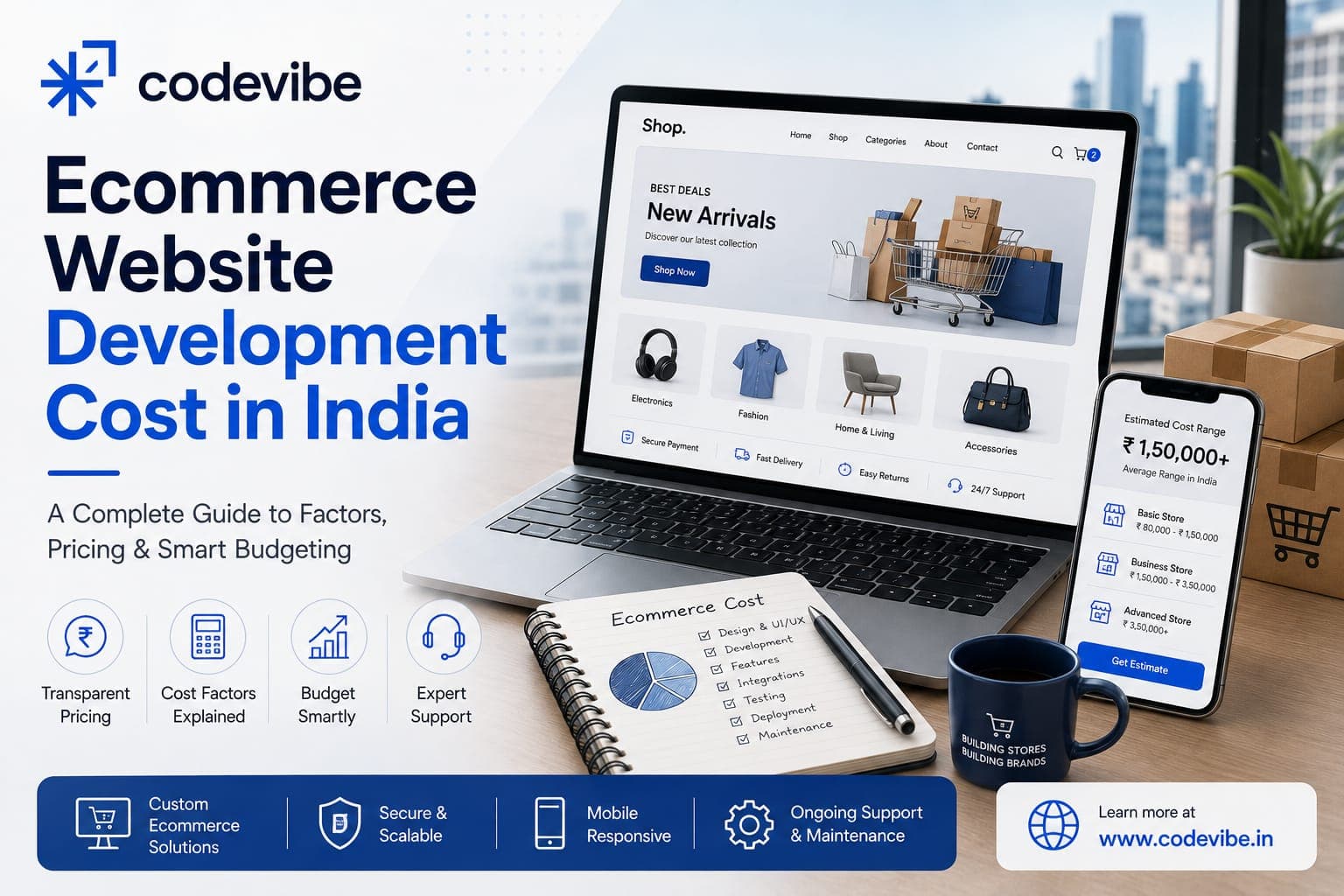
An ecommerce website in India costs between ₹50,000 and ₹25 lakh or more in 2026: a small Shopify or WooCommerce store lands around ₹60,000–₹1.5 lakh, while a custom, scalable platform runs from ₹3 lakh upward. What moves that number is scope — catalogue size, design, and integrations — not the platform's logo (Shopify India).
That range is wide for a reason: an "ecommerce website" can mean anything from a five-product boutique store to a multi-vendor marketplace handling lakhs of orders. Cost also depends on your model - a direct-to-consumer (D2C) store is scoped differently from a B2B ecommerce platform with wholesale tiered pricing, GST-compliant invoicing, and account-based checkout, and both differ again from selling through a marketplace like Amazon or Flipkart. This guide breaks the cost down by tier, by platform, and by the features that actually move the price - so you can budget with confidence before you brief an agency in Gurgaon, Delhi NCR, or anywhere else.
Key Takeaways
- Expect to pay ₹50,000 to ₹1.5 lakh for a basic store, ₹1.5 to ₹5 lakh for a feature-rich mid-range store, and ₹5 to ₹25 lakh+ for a custom or enterprise build (Shopify India).
- Platform choice is the single biggest cost lever: Shopify and WooCommerce keep upfront costs low, while custom builds cost more but remove monthly platform fees and scale further.
- India's e-commerce market reached US$129.72 billion in 2025 and is projected to more than quadruple to US$651 billion by 2034 (a 19.63% CAGR), so a well-built store is a long-term asset, not a one-off expense (IMARC Group).
- Speed pays for itself: a 0.1-second improvement in mobile load time lifted retail conversions by 8.4% in Google's research, which is why performance is worth budgeting for (Think with Google).
How Much Does an Ecommerce Website Cost in India?
An ecommerce website in India costs ₹50,000 to ₹25 lakh or more in 2026, and where you land depends on complexity — catalogue size, design, and integrations — not vanity. A basic store runs ₹50,000–₹1.5 lakh over 2–4 weeks: a templated Shopify or WooCommerce setup with a standard payment gateway and a clean off-the-shelf theme, suited to new brands with up to ~50 products. A feature-rich mid-range store runs ₹1.5–5 lakh over 5–8 weeks, adding custom design, third-party integrations, and conversion features for growing D2C brands. A custom or enterprise build runs ₹5–25 lakh+ over 8–16 weeks, with bespoke architecture, custom inventory logic, and integrations into ERP, CRM, or warehouse systems for high-volume or multi-vendor stores. On top of the one-time build, budget for recurring costs — roughly 15–20% of the build per year for maintenance, plus hosting, domain, an SSL certificate, and payment-gateway fees of about 2% per transaction. The table below summarises the three build tiers (Shopify India).
| Tier | Typical cost (INR) | Best for | Build time |
|---|---|---|---|
| Basic store | ₹50,000 to ₹1,50,000 | New brands, up to ~50 products, standard checkout | 2-4 weeks |
| Mid-range store | ₹1,50,000 to ₹5,00,000 | Growing D2C brands, custom design, integrations | 5-8 weeks |
| Custom / enterprise | ₹5,00,000 to ₹25,00,000+ | High volume, multi-vendor, ERP/CRM integration | 8-16 weeks |
If you want a partner to scope and build the store itself, that's the core of our web development service.
What's Driving the Price?
Five factors do most of the heavy lifting on your final quote:
- Number of products and categories. A 20-SKU store is far simpler to build and manage than a 5,000-SKU catalogue with variants and filters.
- Design. A ready-made theme is cheap; a fully custom UI built around your brand costs more but converts better.
- Integrations. Payment gateways, shipping/logistics APIs, GST-compliant invoicing, ERP, and CRM connections each add development time.
- Custom features. Subscriptions, loyalty programs, multi-vendor support, and personalised recommendations are where budgets climb.
- Scalability. Building to handle festive-season traffic spikes (think Diwali and Big Billion Days) costs more upfront but prevents crashes when it matters most.
Which Platform Should You Choose - and What Does It Cost?
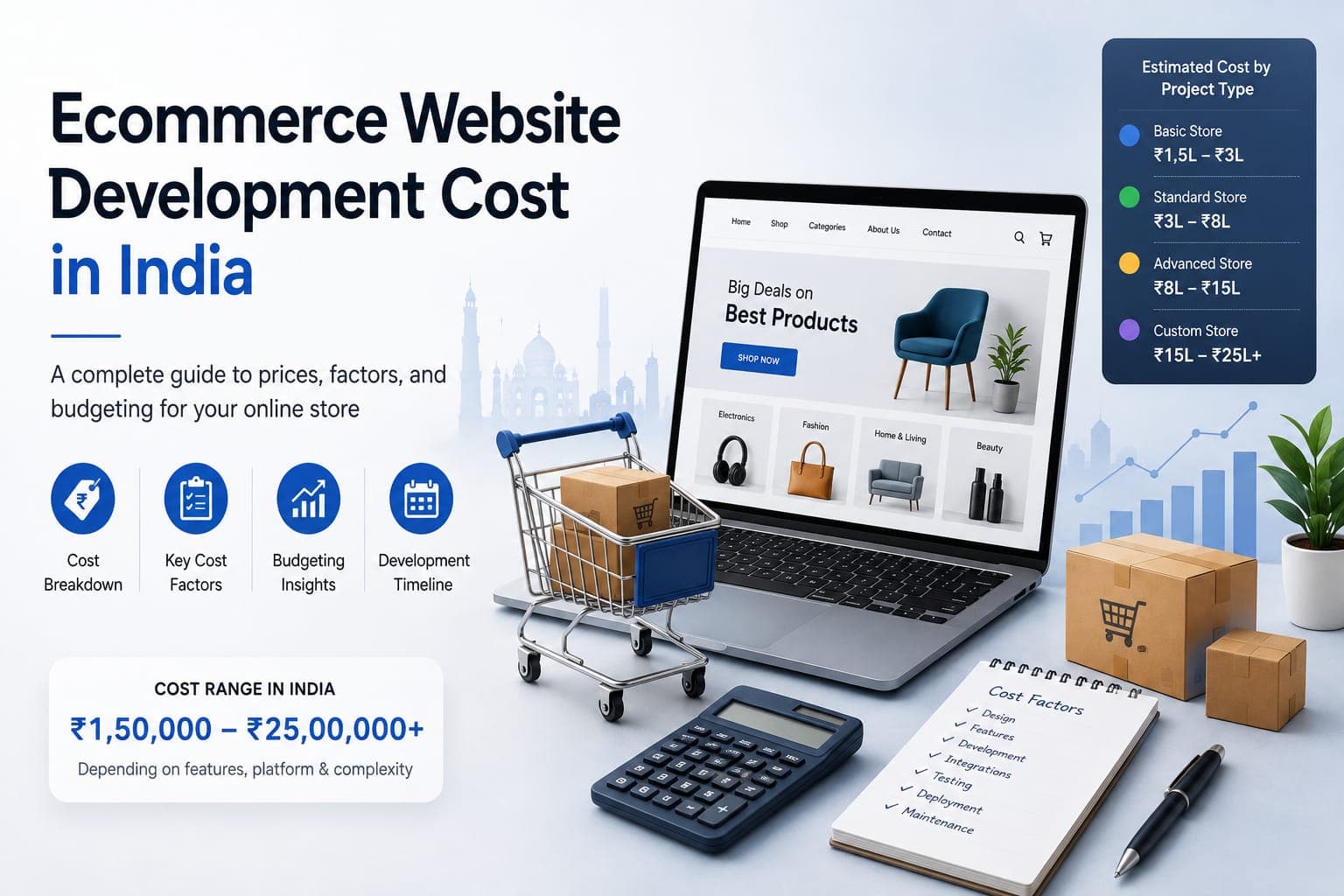
For most Indian stores, Shopify or WooCommerce is the right starting point, and a custom build is worth it only once you outgrow them. Shopify costs ₹60,000 to ₹3 lakh upfront, WooCommerce ₹50,000 to ₹4 lakh, and a custom build ₹5 lakh+. Platform choice is the biggest single cost lever, because it sets both your upfront and your ongoing costs. Here's how the three routes compare for the Indian market.
| Platform | Upfront cost (INR) | Ongoing cost | Best for |
|---|---|---|---|
| Shopify | ₹60,000 to ₹3,00,000 | Plan from ~₹2,000/mo + transaction fees | Fast launch, low maintenance |
| WooCommerce (WordPress) | ₹50,000 to ₹4,00,000 | Hosting + plugins (~₹1,000 to 5,000/mo) | Flexibility, content + commerce |
| Custom build | ₹5,00,000+ | Hosting + maintenance AMC | Scale, unique workflows, no platform lock-in |
Shopify is the quickest path to launch and the easiest to maintain, but you pay a monthly plan and per-transaction fees. WooCommerce gives you more control and pairs commerce with content marketing, though you own the maintenance burden. A custom build costs the most upfront but eliminates recurring platform fees and removes the ceiling on what you can do as you scale.
Two other routes suit specific cases. Magento (Adobe Commerce) is built for large, high-SKU catalogues and complex B2B pricing rules, but its development and hosting costs sit well above the tiers here. A headless or PWA storefront - a decoupled front end (typically Next.js) over a commerce API - delivers the best performance and design freedom for brands where the storefront itself is a differentiator, again at a higher build cost. For a first store, though, Shopify or WooCommerce is almost always the pragmatic choice.
For most small and mid-sized Indian businesses, Shopify or WooCommerce is the sensible starting point. A custom build makes financial sense once your order volume, catalogue size, or operational complexity outgrows what a hosted platform can handle gracefully. Our WordPress and WooCommerce buyer's guide digs deeper into the Shopify-versus-WooCommerce trade-off.
Don't Forget the Recurring Costs
The build is only part of the picture. Budget for these every year:
- Domain and hosting: roughly ₹5,000 to ₹30,000/year depending on traffic and platform.
- SSL certificate: often bundled with hosting, otherwise ₹2,000 to ₹8,000/year.
- Maintenance (AMC): plan for 15-20% of the build cost annually to cover security updates, bug fixes, and small enhancements.
- Payment gateway fees: Indian gateways like Razorpay, PayU, and Cashfree typically charge around 2% per transaction plus GST, and UPI now drives the majority of online checkouts - so gateway choice and UPI success rate feed directly into your running costs.
Ongoing upkeep is part of what we cover under our web development service, so the store stays fast and secure after launch.
Why Spending on Quality Pays Off
A well-built ecommerce store pays for itself through higher conversions, while the cheapest quote often costs more in lost sales. It's tempting to choose the lowest price, but an ecommerce store is a revenue engine, and cutting corners on the engine is expensive. The average ecommerce conversion rate sits at roughly 2.5-3%, with desktop converting at about 4.8% versus 2.9% on mobile (Speed Commerce). Small improvements in design, speed, and checkout flow lift that number - and at scale, a fraction of a percent is real money.
Speed is the clearest example. 53% of mobile visitors abandon a page that takes longer than three seconds to load, and Google's research found that a 0.1-second improvement in mobile load time increased retail conversions by 8.4% (Think with Google). A site built in 1 second converts at roughly 5x the rate of one that takes 10 seconds (Portent). The cheapest store that loads slowly will quietly lose you more revenue than the price difference of building it well - we break the numbers down in how fast a website should load.
With India's e-commerce market at US$129.72 billion in 2025 and on track to reach roughly US$651 billion by 2034 at a 19.63% CAGR (IMARC Group), the upside of a fast, well-built store compounds year after year. The right question isn't "what's the cheapest store I can get?" - it's "what store will pay for itself fastest?"
What Does an Ecommerce Website Cost in Gurgaon and Delhi NCR?
Pricing in Gurgaon and Delhi NCR broadly tracks the national tiers above, since most agencies serve clients across India. A basic store from a Gurgaon agency typically starts around ₹60,000 to ₹1,50,000, with mid-range D2C builds in the ₹2 to 5 lakh band and custom platforms quoted on scope.
What you're really paying for with a local partner is closer collaboration: in-person discovery sessions, easier coordination on brand and product photography, and a team in your timezone for launch-day support and ongoing maintenance. For brands in Delhi NCR that value face-to-face planning and a hands-on relationship through festive-season traffic, that proximity often justifies a small premium over the cheapest remote quote. Our guide to choosing a web development company in Gurgaon covers how to vet a local partner.
How to Get an Accurate Quote
To turn these ranges into a firm number, give any agency three things up front:
- Your catalogue size - rough product count and number of categories or variants.
- Your must-have features - payment gateways, subscriptions, multi-vendor, loyalty, and any ERP/CRM integrations.
- Your design expectation - template-based, semi-custom, or fully bespoke.
With those details, a good agency can scope your project to a tight range rather than the broad ₹50,000 to ₹25 lakh window. The clearer your brief, the more accurate - and competitive - the quote. Want a ballpark before you brief anyone? Our project cost estimator turns your project type, scope and features into an indicative range in under a minute.
Frequently Asked Questions
How much does it cost to build an ecommerce website in India?
In 2026, an ecommerce website in India costs between ₹50,000 and ₹25 lakh or more. A basic store runs ₹50,000 to ₹1.5 lakh, a feature-rich mid-range store costs ₹1.5 to 5 lakh, and a custom or enterprise build starts around ₹5 lakh and can exceed ₹25 lakh, depending on features, integrations, and scale (Shopify India).
Is Shopify or WooCommerce cheaper for an Indian store?
Both keep upfront costs low. WooCommerce can be slightly cheaper to start because the software is free - you pay only for hosting, a theme, and plugins. Shopify charges a monthly plan plus transaction fees but bundles hosting, security, and maintenance, which lowers your operational overhead. Over a few years, total cost often evens out; the better choice depends on whether you value low maintenance (Shopify) or maximum flexibility (WooCommerce).
How long does it take to build an ecommerce website?
A basic store usually takes 2-4 weeks, a mid-range custom-designed store takes 5-8 weeks, and a complex enterprise or multi-vendor platform can take 8-16 weeks or longer, depending on the number of integrations and rounds of revision.
What are the ongoing costs of running an ecommerce website?
Budget for domain and hosting (₹5,000 to ₹30,000/year), an SSL certificate (often bundled, otherwise ₹2,000 to ₹8,000/year), payment gateway fees (around 2% per transaction), and annual maintenance - typically 15-20% of the build cost to cover security updates, bug fixes, and enhancements.
Why do ecommerce website quotes vary so much?
The biggest variables are catalogue size, design (template vs custom), the number of integrations, custom features like subscriptions or multi-vendor support, and how much the site is built to scale during traffic spikes. Two stores that look similar can differ in price by several lakhs based on these factors.
Does a faster ecommerce website really earn more?
Yes. Google's research found a 0.1-second improvement in mobile load time lifted retail conversions by 8.4%, and 53% of mobile visitors abandon a page that takes longer than three seconds to load (Think with Google). Investing in performance typically pays for itself through higher conversion rates.
The Bottom Line
Ecommerce website development in India spans a wide range - ₹50,000 for a templated starter store up to ₹25 lakh or more for a custom, scale-ready platform - and the right number depends on your catalogue, features, and growth plans, not on whoever quotes lowest. Pick the platform that matches your stage, budget for the recurring costs, and treat speed as an investment rather than an expense.
Planning an online store? CodeVibe builds fast, conversion-focused ecommerce websites for brands across Gurgaon and Delhi NCR. Tell us what you're building and we'll come back with a fixed-scope quote.
Last reviewed: 3 September 2026 — pricing bands and market figures re-verified against primary sources, and coverage expanded across platforms (Magento, headless/PWA), payment gateways, and D2C/B2B models.