

If you're a founder reading this on a Sunday at midnight, you already know the score. The idea is good. The market is real. Now you need to ship something fast - without spending half your seed round before a single user logs in.
This is the short version of the conversation we have with founders almost every week.
Key Takeaways
- A well-scoped MVP in 2026 takes 6 to 12 weeks and costs between $15,000 and $80,000 (Modall, 2026).
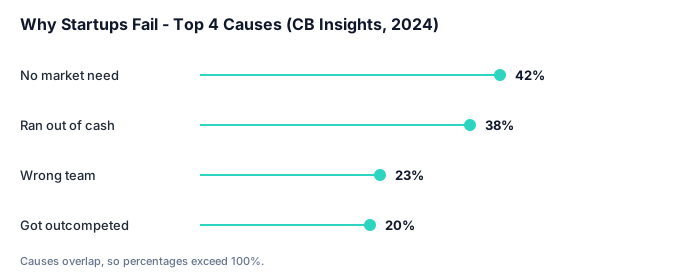
- 42% of startups fail because they build products nobody wants - a scoping problem, not an engineering one (CB Insights, 2024).
- AI-assisted development has compressed delivery timelines by 40 to 60% for teams that use it well (McKinsey, 2025).
- Outsourcing to India can cut costs by 35 to 45% versus a US-based in-house team (Everest Group, 2025).
What does an MVP actually mean in 2026?
A modern MVP is a small, working product - usually three to five core features - built well enough to put in front of paying users within 90 days (Modall, 2026). It's not a prototype, not a Figma file, and not version one of a ten-year roadmap. It's the smallest thing that proves people will pay.
The products we've shipped that survived to a Series A had one thing in common - they launched with fewer than five user-facing features. The ones that pivoted or died usually launched with twelve or more.
How much does MVP development cost?
A simple MVP in 2026 costs $15,000 to $40,000. A medium-complexity product - a marketplace, an AI workflow, light fintech - runs $40,000 to $80,000. Complex builds with integrations or compliance can hit $120,000+ (ideas2it, 2026).
Three things drive the spread: team composition (a senior-led three-to-five-person team is the sweet spot), geography (US engineers bill $150 to $250/hr versus $40 to $70/hr in India), and stack choice. A Next.js + Postgres + Vercel stack ships faster and cheaper than AWS microservices for the same feature set.

How long does it take to build a startup MVP?
Six to twelve weeks. That's the honest answer for 80% of MVPs we see (wearepresta, 2026). If your timeline is creeping past four months, you're not building an MVP - you're building a v1, and you should stop pretending otherwise.
Our delivery data is clear on one thing: projects that spend the first 5 to 7 days on architecture, data models, and API contracts ship two to three weeks faster than projects that "just start coding."
What's the right tech stack for an MVP?
For most consumer and B2B SaaS MVPs, our 2026 default is Next.js on Vercel, Postgres on the backend, and React Native for mobile. React is used by 44.7% of professional developers globally and Next.js ranks fourth among web frameworks (Stack Overflow, 2025). Mainstream stacks are not an aesthetic choice - they're a hiring decision.
Read our detailed take in Why We Choose Next.js for Every Web Project and the honest React Native vs Native comparison.
Why do most MVPs fail before launch?
Scope. Almost always scope. CB Insights ranks "no market need" as the single biggest cause of startup death at 42% (CB Insights, 2024). Founders build too many features, run out of money, and never get to the iteration that would have found product-market fit.
Our rule of thumb: If you can't describe your MVP's job in one sentence, the spec is too big.
In-house team or development partner?
For pre-seed and seed-stage startups, a development partner is usually the right call for the first six to twelve months. Hiring three to five senior engineers takes four to nine months before they ship anything serious. A senior-led agency ships in week one. According to Deloitte, over 70% of companies rely on outsourcing to drive efficiency (Deloitte, 2024).
Three traps to dodge: agencies that talk senior but ship junior, fixed-bid pricing on undefined scope, and handovers that never happen. Ask for engineer names. Use hybrid pricing. Agree on handover format on day one. For a complete vetting framework, see our guide to choosing a web development company.
Frequently asked questions
What's the difference between a prototype and an MVP?
A prototype is a non-functional simulation - often a clickable Figma file. An MVP is a real, working product that paying users can use today. The test is simple: can someone pay you for it right now? If no, it's a prototype.
How many features should a startup MVP launch with?
Three to five. More than five and you're almost certainly building too much. Research shows more than 80% of features in launched apps go unused, which means every extra feature is a coin-flip on whether anyone touches it.
Can you build an MVP with no-code tools in 2026?
Yes, for simple SaaS or marketplace MVPs. Tools like Bubble can ship a build in 4 to 6 weeks for $5K to $15K (Modall, 2026). The ceiling comes fast though - once you need custom logic or AI features, no-code gets expensive.
Is React Native good enough for a startup mobile MVP?
For 90% of mobile MVPs, yes. It delivers near-native performance from a single codebase, which roughly halves build cost. We've shipped consumer apps to the App Store in 10 to 11 weeks using it.
What this means for your next 90 days
Write your MVP's job in one sentence. List three core user actions. Pick a hireable stack. Budget 8 to 12 weeks and $30K to $80K for a senior-led build. Then plan three months of iteration after launch - that's where product-market fit actually happens.
You don't need to build the perfect product. You need to build the smallest one that proves you should build the next thing.
Ready to build your MVP?
We're Codevibe - a senior-led engineering team in Gurgaon serving global startups. We ship production MVPs in 6 to 12 weeks across web, mobile, cloud, and AI. Response time on new project enquiries: under 12 hours.
Start a project → · Explore web development services · See our case studies · Email hello@codevibe.in