

Picking a web development company is one of the highest-stakes decisions a founder makes - and most do it on gut feel and a polished sales call. The wrong choice doesn't just cost money; it costs months you can't get back. Here's the honest version, from a team that has both won and lost these pitches.
Key Takeaways
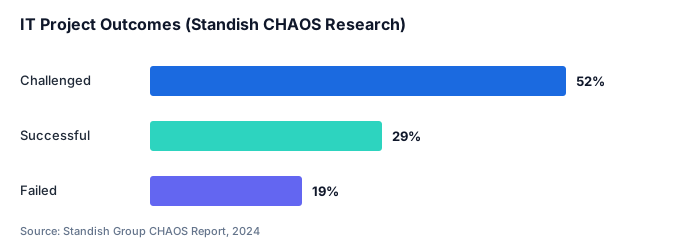
- Only 29% of IT projects succeed - 19% fail outright and 52% land late, over budget, or under scope (Standish Group, 2024).
- Vendor selection affects project success more than almost any other early decision you make.
- Portfolio depth beats portfolio size - two detailed case studies tell you more than twenty screenshots.
- The biggest red flag is an agency that jumps to "what to build" before asking "what problem are we solving?"
Why does choosing the right web development company matter so much?
Because the odds are not in your favour. According to the Standish Group's CHAOS research, only 29% of IT projects succeed - 19% fail completely, and 52% finish late, over budget, or missing features (Standish Group, 2024). The single biggest swing factor isn't the technology. It's who you hand the work to.
A capable partner turns a vague idea into a shipped product. A poor one burns your runway, hands you fragile code, and leaves you starting over. Same budget, wildly different outcomes - and the difference is decided before the first line of code is written.

What should you look for in a web development company?
Look for senior engineering, proven outcomes, and clear communication - in that order. McKinsey research found just 47% of IT projects finish on time and 44% deliver their intended benefits (McKinsey, 2025). The partners who beat those odds share a few honest signals.
Here's what actually predicts a good engagement:
- Senior engineers on your project. Ask who specifically writes your code. Get names. A team that leads with senior developers - not juniors badged as seniors - is the strongest single indicator of quality.
- Portfolio depth, not breadth. Two case studies with real business outcomes (conversion lifts, time-to-market, retention) say more than twenty pretty screenshots.
- Communication quality. Notice response time, how clearly they explain technical trade-offs, and whether they ask sharp questions early. That behaviour in the sales process is the behaviour you'll get all project.
- Product thinking. A good partner challenges your assumptions before building. They ask "what problem are we solving?" - not just "what features do you want?"
When we pitch, the projects that go best always start the same way: the client lets us push back on the spec. The ones that struggle are where scope was frozen before anyone asked why.
What are the red flags that should make you walk away?
Some warning signs are loud enough to end the conversation. The clearest is an agency that jumps straight to "here's what we'll build" without first asking what business problem you're solving. If they're not curious about your users, they're order-takers, not partners.
Watch for these too: the bait-and-switch, where senior engineers pitch and juniors deliver - always ask who is actually assigned. The fixed-bid-on-vague-scope trap, which sounds safe but punishes every change you'll inevitably need to make. And the no-handover problem - if code ships without documentation, tests, and CI/CD, you've been handed debt, not an asset.

One more: an agency that never says no. A partner worth hiring will tell you when a feature isn't worth building. For more on scoping a lean first build, see our MVP development guide for startups.
How do you compare quotes and proposals fairly?
Compare scope and seniority, not just the bottom-line number. A junior offshore team and a senior-led agency can quote the same project at a 3x gap - and the cheaper number often hides slower delivery and weaker architecture. Ask every shortlisted company for an itemised, feature-by-feature estimate so you can see what each decision actually costs.
Then weigh the total cost of ownership, not the sticker price. Our SaaS tech stack guide explains which technical choices keep long-term costs low, and the Next.js web framework breakdown shows why a modern stack pays for itself. A quote that ignores maintenance, testing, and handover isn't cheaper - it's just incomplete.
Frequently asked questions
What matters most when choosing a web development company?
Vendor selection affects project success more than almost any other early decision. With only 29% of IT projects succeeding (Standish Group, 2024), the priority is senior engineering talent and proven outcomes - a team that has shipped real products, not one with the lowest quote.
How much should I budget for a web development project?
Most business web applications cost ₹18 lakh to ₹60 lakh in 2026, with simpler sites lower and enterprise builds far higher. Always request a feature-by-feature estimate rather than a lump sum, and budget 15-20% of the build cost per year for ongoing maintenance.
Is it safe to outsource web development to an offshore company?
Yes, when you vet for seniority and communication. Many offshore failures trace back to poor vendor selection, not geography. A senior-led offshore team delivers reliably - and at 35-45% lower cost than a comparable in-house team once all overheads are counted (Everest Group, 2025).
What questions should I ask before hiring a web development company?
Ask who specifically writes your code, for two detailed case studies with business outcomes, how they handle scope changes, and what the handover includes. A confident partner answers all four directly. Vague or evasive answers are a reliable signal to keep looking.
The bottom line
Choosing a web development company is really a bet on people. The technology matters, but a senior team that asks hard questions and treats your product like their own beats a cheaper option every time. The strongest partners also build for where the web is heading - mobile-first and AI-readable, the shifts we cover in our 2026 web development trends. Take the extra week. Check the references. Ask who writes the code.
Looking for a web development partner?
We're Codevibe - a senior-led web development team in Gurgaon serving global startups. Senior engineers on every project, transparent pricing, and no bait-and-switch. Response time on new project enquiries: under 12 hours.
Start a project → · Explore web development services · Email hello@codevibe.in