

Pick the wrong tech stack and you'll spend two years apologising for it. Pick the right one and your team moves twice as fast for half the cost. Here's the short version of how we answer that question every week.
Key Takeaways
- The modern SaaS default in 2026 is Next.js + TypeScript + PostgreSQL + Vercel (Vercel SaaS Templates, 2026).
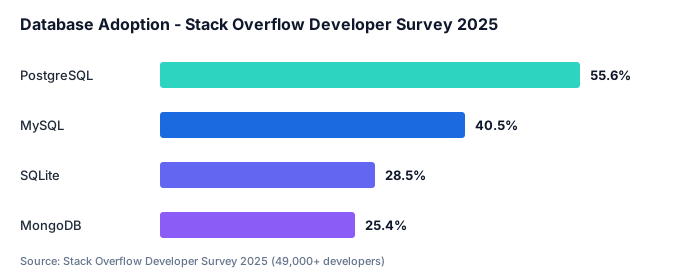
- PostgreSQL adoption hit 55.6% in 2025 - a 15-point lead over MySQL (Stack Overflow Survey, 2025).
- React is used by 44.7% of professional developers, making it the safest hiring decision (Stack Overflow Survey, 2025).
- You can run a modern SaaS stack at $0/month during MVP and under $200/month at $1K MRR.
What is the best tech stack for a SaaS startup in 2026?
For most early-stage SaaS products, the modern default is Next.js + TypeScript + PostgreSQL + Vercel + Stripe. According to the 2025 Stack Overflow Developer Survey of 49,000+ developers, this stack hits top adoption in every category (Stack Overflow, 2025). Popular stacks have better docs, more libraries, and a deeper hiring pool - it's a flywheel.
The stack we default to at Codevibe in 2026:
- Next.js 15 + React + TypeScript on the frontend
- PostgreSQL + Prisma for data
- Vercel or Railway for hosting (move to AWS at scale)
- Stripe for billing
- Clerk or Supabase Auth for users
- Sentry + PostHog for observability and product analytics
- React Native + Expo if mobile ships in v2
Total monthly cost during MVP: roughly $0. At $1K MRR: under $200. We covered the framework choice in detail in Why We Choose Next.js for Every Web Project.

Why is Next.js the SaaS default in 2026?
Because the hiring market says so. React holds 44.7% adoption among professional developers globally, and Next.js sits as the fourth-most-popular web framework in the 2025 Stack Overflow Survey (Stack Overflow, 2025). Next.js gives you server-side rendering, static generation, edge functions, and a great developer experience in one package. For SaaS, that means SEO works out of the box, marketing pages and the app share a codebase, and your engineers stop wasting weeks on build configuration. That built-in performance and SEO edge matters more every year - our 2026 web development trends explains why mobile speed now decides rankings.
We've shipped 30+ products on this stack over the last four years. The only times we've reached for something else were when an existing team had deep Rails or Django experience - and even then, the frontend usually ended up on Next.js anyway.
Which database should you pick for a SaaS product?
PostgreSQL. Almost always PostgreSQL. The 2025 Stack Overflow Survey shows it at 55.6% adoption - up nearly seven points from 2024 and 15 points ahead of MySQL (Stack Overflow, 2025). It's also the most admired (65%) database in the survey, which directly affects your hiring funnel.
When does PostgreSQL break down? Almost never for SaaS. If you eventually hit serious analytics scale, add ClickHouse alongside it - don't replace it.
When should you choose AWS over Vercel?
When you outgrow the convenience tier. Vercel, Railway, and Render are perfect from day one through about $10K to $20K MRR. After that, your bill starts climbing and you lose flexibility on networking, secrets, and compliance. That's when AWS earns its complexity premium.
Our rule: start on the convenience tier, move to AWS when the bill exceeds $1,500/month or compliance demands it - whichever comes first. We wrote about the cost-side of that decision in AWS Cost Optimisation: A Practical Guide for Startups.
What tech stack mistakes do startups regret most?
Three patterns kill more SaaS projects than anything else:
- Picking what's exciting instead of what's hireable. Choosing Rust, Elixir, or a niche framework feels great until you need your fifth engineer and the candidate pool is 50 people globally.
- Premature microservices. Splitting a 5-person team into 12 services adds latency, complexity, and three months to every release. A clean monolith scales to ten million users before architecture matters.
- Custom auth. Don't. Use Clerk, Supabase, or Auth0. Every hour spent building login flows is an hour not spent on the thing your users actually pay for.
Frequently asked questions
Should I use TypeScript or JavaScript for a SaaS startup?
TypeScript, every time. The 2025 Stack Overflow Survey shows TypeScript adoption climbing fast, with most modern SaaS templates and starter kits assuming it by default. The upfront cost is one week of slower writing in exchange for years of fewer runtime bugs. For any team larger than one engineer, it pays back inside a month.
Is Next.js better than Remix or Astro for SaaS?
For SaaS, yes. Next.js has the largest ecosystem, the deepest documentation, and the most hireable talent pool. Remix is excellent technically but the community is smaller. Astro is best for content-heavy marketing sites, not app-heavy SaaS. If you're picking one stack to bet on through Series B, Next.js is the safest call.
Do I need React Native if I'm building a SaaS?
Not at launch. About 80% of SaaS products live happily as web apps for the first 18 months. Add mobile when usage data shows users coming back daily on small screens. We covered the trade-offs in React Native vs Native: An Honest Comparison.
What database is best for an AI-powered SaaS?
PostgreSQL with the pgvector extension. It handles relational data and vector embeddings in the same database - no need for a separate Pinecone or Weaviate at MVP scale. Add a dedicated vector database only when you exceed 10M embeddings or need sub-50ms search at high QPS.
What this means for your build
Pick the boring, popular stack. Save your originality for the product, not the infrastructure. The startups that ship fast in 2026 are not the ones with the cleverest tech - they're the ones whose stack stopped being a topic of conversation by month two.
Need help picking your stack?
We're Codevibe - a senior-led engineering team in Gurgaon serving global startups. We've shipped SaaS on this exact stack for four years. Response time on new enquiries: under 12 hours.
Start a project → · Explore web development services · See our case studies · Email hello@codevibe.in