

Every December, the internet fills up with "web development trends" lists. Most are noise - predictions nobody acts on. So we cut ours down to the few shifts that actually changed how we build and what we tell clients in 2026. No buzzwords. Just the things that move revenue, rankings, or risk.
Key Takeaways
- AI now assists nearly half of all newly written code, yet only about a third of developers trust its output (Stack Overflow, 2025).
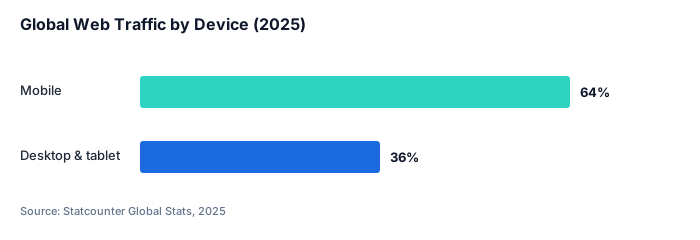
- Mobile drives 64% of global web traffic - Google ranks the mobile version of your site, not the desktop one (Statcounter, 2025).
- Core Web Vitals now decide whether you appear in AI Overviews - slow sites lose both organic and AI-cited traffic.
- The new skill is GEO - getting your content cited by AI search engines, not just ranked on Google.
Is AI really writing half your code now?
Close to it. As of early 2026, AI assists nearly half of all newly written code, and 85% of developers use AI tools weekly for coding, debugging, or review (Stack Overflow, 2025). McKinsey reports that 88% of companies now use AI regularly in at least one function (McKinsey, 2025). So yes - the shift is real, and it's fast.
But here's the part the hype cycle skips. Developer trust in AI output has fallen to roughly one in three, down from over 70% two years ago (Stack Overflow, 2025). AI writes code quickly. It doesn't always write code that's correct, secure, or maintainable.
Our take: AI is a fantastic intern and a terrible architect. It speeds up the typing. It does not replace the judgement of a senior engineer who knows why one approach will quietly break in six months. Teams that ship well in 2026 use AI to go faster - then have humans review everything that matters.

Why does mobile performance decide your rankings in 2026?
Because Google now judges your site by its phone version, and 64% of global web traffic comes from mobile (Statcounter, 2025). Mobile-first indexing means the slow, cramped experience on a mid-range Android - not your polished desktop build - is what determines where you rank.
Core Web Vitals - load speed, responsiveness, visual stability - are no longer a technical footnote. A page that takes over three seconds to load loses 53% of mobile visitors before it even renders (Think with Google). And there's a new stakes layer: poorly performing pages rarely show up in AI-generated search answers at all.
If your site feels sluggish on a phone, that's not a polish problem. It's a traffic problem. Our SaaS tech stack guide covers the framework choices that keep performance high from day one.
What is GEO, and why should you care?
GEO - Generative Engine Optimization - is the practice of getting your content cited by AI search engines like ChatGPT, Perplexity, and Google's AI Overviews. In 2026, ranking on page one isn't the whole game anymore. More users ask an AI a question and never click a blue link at all.
We've watched this shift in our own analytics. Pages structured with clear, direct answers - a real sentence that answers the question in the first 50 words - get pulled into AI responses far more often than pages that bury the answer under 600 words of preamble.
The fix isn't mysterious. Write answer-first. Use plain headings that match real questions. Keep your facts specific and sourced. A fast, well-structured site is now the price of entry for both Google and the AI tools sitting on top of it.

Which trends are hype - and which are real?
Plenty of 2026 "trends" are vendor marketing in disguise. Here's our honest sort. Real and worth your attention: AI-assisted development, mobile performance, GEO, accessibility, and serverless architecture for lean teams. Mostly hype for the average business: Web3 everything, AI chatbots bolted onto sites that didn't need them, and over-engineered animations that wreck Core Web Vitals.
The pattern is simple. A trend matters if it changes revenue, rankings, or risk. If it only changes how a demo looks on stage, you can safely ignore it for another year.
Frequently asked questions
Will AI replace web developers in 2026?
No. AI assists nearly half of new code, but developer trust in that output has dropped to roughly one in three (Stack Overflow, 2025). AI speeds up routine work - it doesn't replace the architecture decisions, security judgement, and debugging that senior engineers handle.
What is the most important web development trend in 2026?
Mobile performance. With 64% of traffic on mobile and Google using mobile-first indexing, your phone-version Core Web Vitals decide your rankings. Slow sites now lose visibility in both traditional search and AI-generated answers, making speed the highest-impact area to fix.
Do I need to optimise my website for AI search?
Yes, if organic traffic matters to you. AI search engines increasingly answer questions without sending a click. Structuring content answer-first - a clear, direct response in the opening lines - makes your pages far more likely to be cited by ChatGPT, Perplexity, and Google AI Overviews.
Is it worth rebuilding a site just to follow 2026 trends?
Rarely. Rebuild when performance, security, or maintainability is actively costing you - not to chase a trend. Most sites need targeted fixes (speed, mobile UX, content structure) rather than a full rewrite. Audit first, then decide.
The bottom line
The 2026 web is faster, more mobile, and increasingly read by machines before humans. You don't need to chase every trend on every list. You need a site that loads quickly on a phone, answers questions clearly, and is built by people who know which shortcuts will cost you later. That's it. Everything else is detail.
If you're planning a build, our guide to choosing a web development company covers how to pick a partner who builds for this faster, more AI-readable web.
Building for the 2026 web?
We're Codevibe - a senior-led web development team in Gurgaon serving global startups. We build fast, mobile-first web applications optimised for both Google and AI search. Response time on new project enquiries: under 12 hours.
Start a project → · Explore web development services · Email hello@codevibe.in